
Idioma / Language: Español · English
«Anatomía de un asesinato»: el juicio que sigue dando clase
La película de Otto Preminger (1959) como recurso para el aula: qué ha cambiado en el proceso penal desde entonces, cómo se analiza un crimen desde la mirada de cada profesional y por qué la escena de «la lección» sigue dividiendo a los estudiantes.
¿Hasta dónde puede llegar un abogado para salvar a su cliente?
Autor: Manuel Castelló G. y José Francisco L. Alonso
Un asesinato que nadie llega a ver
En un pueblo de la península superior de Míchigan, el teniente del ejército Frederick Manion entra en el bar de la posada local y mata a tiros a su dueño, Barney Quill. No huye ni lo niega. Su mujer, Laura, cuenta que esa misma noche Quill la violó y le dio una paliza. El caso llega a Paul Biegler, antiguo fiscal del condado que perdió las elecciones y pasa los días pescando truchas, tocando jazz al piano y discutiendo de leyes con un viejo amigo alcohólico. Así arranca Anatomía de un asesinato (Anatomy of a Murder, Otto Preminger, 1959), y lo más llamativo de sus dos horas y cuarenta minutos es lo que deja fuera de plano, porque el espectador nunca ve la violación ni el disparo. Todo lo que sabe del crimen le llega a través de lo que cuentan los personajes, de lo que el juez deja decir y de lo que el jurado acaba creyendo.
Esa decisión de guion, que en 1959 era casi una provocación, convierte la película en un material de primera para cualquier aula de Derecho, Criminología o Psicología jurídica. James Stewart, Lee Remick, Ben Gazzara y un joven George C. Scott sostienen un juicio rodado en el auténtico palacio de justicia del condado de Marquette, con música de Duke Ellington y los títulos de crédito de Saul Bass. Tuvo siete candidaturas al Óscar, no ganó ninguna y en 2012 entró en el Registro Nacional de Cine de Estados Unidos. Para el papel de juez, Preminger fichó a Joseph N. Welch, el abogado que en 1954 se había enfrentado en directo por televisión al senador Joseph McCarthy, de modo que el magistrado de la ficción tenía detrás una carrera real en los tribunales.
Con esta película, la serie Cine con rigor cambia un poco el foco. Analizaremos la cinta como un recurso didáctico para profesores, formadores y especialistas que quieran llevar el derecho y las ciencias forenses al aula de una forma amena, con una pregunta de debate concreta y una dinámica que se pueda aplicar al día siguiente. Este artículo mira Anatomía de un asesinato desde dos ángulos: cuánto ha cambiado el proceso penal desde 1959, que es el eje principal, y cómo un mismo crimen se analiza de forma seria desde la mirada de cada profesional que interviene. La propuesta de debate gira en torno a la escena más discutida de la película, la llamada «lección».
Ficha para el aula
- Título original: Anatomy of a Murder (Estados Unidos, 1959), en blanco y negro, 160 minutos.
- Dirección y guion: Otto Preminger; guion de Wendell Mayes sobre la novela de Robert Traver (1958).
- Materias: Derecho Penal y Procesal Penal, Deontología profesional, Psicología jurídica y forense, Psiquiatría forense, Criminología y Victimología.
- Nivel recomendado: grado y posgrado; con fragmentos escogidos, también bachillerato y formación profesional.
- Pregunta de debate: ¿Explicar la ley al cliente antes de oír su versión es asesoramiento legítimo o la fabricación de una defensa?
- Advertencia: trata una violación y un homicidio, con el lenguaje y los prejuicios de su época, que conviene presentar y comentar.
Del caso Peterson a la novela de un juez
La historia tiene un original. El 31 de julio de 1952, el teniente Coleman A. Peterson mató a tiros a Maurice Chenoweth en la Lumberjack Tavern de Big Bay, un pueblo a orillas del lago Superior; su mujer, Charlotte, declaró que Chenoweth la había violado y golpeado. El abogado defensor fue John D. Voelker, fiscal del condado durante años, que planteó una variante de la eximente de enajenación casi olvidada en Míchigan desde 1886: el impulso irresistible. El juicio empezó el 15 de septiembre y, el 23, el jurado absolvió a Peterson por razón de enajenación tras unas cuatro horas de deliberación. Dos días más tarde, un psiquiatra lo declaró cuerdo y quedó en libertad.
Voelker contó el caso en una novela que firmó como Robert Traver y publicó en 1958, cuando ya era magistrado del Tribunal Supremo de Míchigan. El éxito del libro le permitió dejar la toga y dedicarse a escribir y a pescar. La película siguió la novela muy de cerca y se rodó en los mismos lugares, tan de cerca que en 1960 la hija de Chenoweth demandó por difamación a la editorial y a Columbia Pictures, alegando que la ficción calcaba los hechos y retrataba mal a las mujeres implicadas; la demanda se desestimó en 1961. Para el aula, ese pleito abre una pregunta lateral que también merece debate: qué obligaciones tiene quien convierte un crimen real en entretenimiento frente a las víctimas y a sus familias.
Lo que ha cambiado en la sala desde 1959
Vista hoy, la película funciona como una fotografía de un sistema procesal que ya no existe tal cual. Casi todos los conflictos del juicio tienen una respuesta legal distinta setenta años después, y repasarlos permite explicar con un caso concreto por qué cambiaron las normas.
La locura ante el tribunal
Biegler necesita una salida legal porque Manion mató a Quill un buen rato después de oír el relato de su mujer, cuando ya no cabía hablar de legítima defensa. La regla general en 1959 era la de M’Naghten, formulada en Inglaterra en 1843, que solo exime a quien, por una enfermedad mental, no sabe lo que hace o no sabe que está mal. Manion lo sabía. El ayudante de Biegler encuentra entonces en la biblioteca jurídica una sentencia del Tribunal Supremo de Míchigan, People v. Durfee (1886), que admitía también la incapacidad para resistir un impulso, siempre que naciera de una enfermedad y no de la simple ira. Ese precedente sostiene toda la defensa: el psiquiatra del ejército habla de una «reacción disociativa» y el de la acusación replica que no existe ningún trastorno de base que la explique (Weiss, 2023).
La historia posterior de esa fórmula es la parte más instructiva. En 1962, el Código Penal Modelo del American Law Institute combinó el criterio cognitivo y el volitivo. Veinte años después, la absolución por enajenación de John Hinckley, que había disparado contra el presidente Reagan en 1981, provocó una reacción inmediata: la Ley de Reforma de la Defensa por Enajenación de 1984 suprimió en los tribunales federales la vertiente volitiva, trasladó al acusado la carga de probar la enajenación de forma clara y convincente y prohibió a los peritos pronunciarse sobre si el acusado tenía o no el estado mental que exige el delito. Varios estados endurecieron sus reglas o directamente abolieron la eximente, y el Tribunal Supremo de Estados Unidos avaló en Kahler v. Kansas (2020) que un estado prescinda del criterio de la incapacidad moral. Míchigan fue en 1975 el primer estado en crear el veredicto de «culpable pero enfermo mental» y hoy conserva una fórmula de tipo ALI con la vertiente volitiva, aunque desde 1994 es la defensa la que debe probar la enajenación por preponderancia de la prueba. Según Weiss (2023), una veintena de jurisdicciones estadounidenses mantiene alguna versión del criterio volitivo.
Conviene dar a los alumnos la proporción real del fenómeno. En el estudio de Callahan et al. (1991) sobre ocho estados, la eximente se alegó en torno al 1 % de los procesos por delito grave y solo prosperó en el 26 % de esos casos. La absolución por locura es mucho más rara en los tribunales que en las películas.
En España el punto de partida es otro. El artículo 20.1 del Código Penal exime a quien, por una anomalía o alteración psíquica, no pueda comprender la ilicitud del hecho o actuar conforme a esa comprensión; la segunda parte de la frase es precisamente la vertiente volitiva que el legislador federal estadounidense eliminó en 1984. El trastorno mental transitorio no exime si el sujeto lo provocó para delinquir, y la absolución puede ir acompañada de una medida de seguridad, porque el artículo 101 permite imponer un internamiento que no puede exceder la pena que habría correspondido. Un caso como el de Manion se discutiría seguramente en otros términos, como la atenuante de arrebato u obcecación del artículo 21.3 o una eximente incompleta, frente a una pena de homicidio de diez a quince años de prisión. Ese contraste es ya un buen ejercicio: ¿absolución, atenuación o condena plena?
La víctima en el banquillo

La paradoja central del juicio es que la violación nunca se juzga, porque su presunto autor está muerto, y sin embargo ocupa media película. La defensa necesita que el jurado crea a Laura para explicar el arrebato de su marido; la acusación necesita desacreditarla. El resultado es un examen minucioso de su vida: cómo vestía, si bebía, si coqueteaba con otros hombres, si su marido dudaba de su fidelidad hasta el punto de hacerla jurar sobre un rosario. Biegler, por su parte, le pide que cuide su aspecto ante el jurado. Laura es testigo, víctima y, en la práctica, acusada.
Pocas normas han cambiado tanto. En 1974 Míchigan aprobó una de las primeras leyes estadounidenses de protección de la víctima frente a su historial sexual (rape shield law), en vigor desde abril de 1975, que solo admite esa prueba en supuestos tasados y previa decisión del juez; las Reglas Federales de Prueba incorporaron en 1978 una norma equivalente, la regla 412. Hay un matiz que conviene que los alumnos descubran por sí mismos: esas leyes protegen a la denunciante en los procesos por delitos sexuales, y el de Manion es un juicio por homicidio. Incluso hoy, la protección no se aplicaría de forma automática a Laura.
En España, el Estatuto de la víctima (Ley 4/2015) prevé medidas para evitar preguntas sobre la vida privada que no tengan relevancia para los hechos, y el artículo 709 de la Ley de Enjuiciamiento Criminal, en la redacción dada por la Ley Orgánica 10/2022, faculta al presidente del tribunal para impedir preguntas innecesarias sobre la intimidad sexual de la víctima y para no permitir que se contesten. La investigación respalda la cautela: la revisión sistemática de Dinos et al. (2015) concluyó que los mitos sobre la violación influyen en cómo los jurados valoran a las víctimas y en sus veredictos. La película, sin proponérselo, ofrece un catálogo completo de esos mitos.
Peritos frente a peritos
El duelo entre el psiquiatra del ejército y el perito de la acusación es otro de los momentos que más ha envejecido. En 1959 regía el criterio Frye, de 1923, que admitía la prueba científica si gozaba de aceptación general en su campo. Desde Daubert v. Merrell Dow Pharmaceuticals (1993), los jueces federales estadounidenses actúan como filtro y valoran la metodología del perito antes de dejarle hablar, un modelo que muchos estados han adoptado después. Además, tras la reforma de 1984, en un tribunal federal el psiquiatra de Biegler no podría decir lo que dice en la película, que el acusado actuó bajo un impulso irresistible: esa conclusión queda reservada al jurado.
En el proceso español los peritos declaran en el juicio oral y el tribunal valora libremente su informe; en los casos de imputabilidad intervienen con frecuencia los médicos forenses de los Institutos de Medicina Legal y Ciencias Forenses. Un ejercicio útil consiste en pedir a los alumnos que redacten las preguntas que harían a cada perito de la película para comprobar si su diagnóstico se apoya en una exploración y en datos, o en la conveniencia de la parte que lo ha propuesto.
Lo que el jurado oye y no debe oír
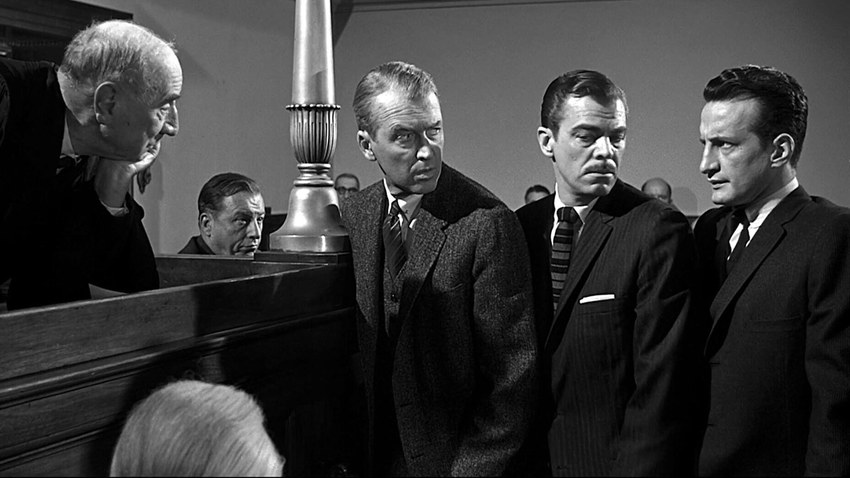
Una de las réplicas más citadas de la película plantea, en esencia, cómo va a olvidar un jurado lo que ya ha escuchado. Biegler introduce información que sabe que será rechazada, el juez ordena que no se tenga en cuenta y el daño ya está hecho. La psicología del jurado le ha dado la razón: el metaanálisis de Steblay et al. (2006), con 48 estudios y más de 8.000 participantes, concluyó que la instrucción de ignorar la prueba inadmisible no elimina su efecto sobre los veredictos, aunque la obediencia mejora algo cuando el juez explica por qué la excluye.
El jurado español también es distinto. El homicidio es competencia del Tribunal del Jurado, formado por nueve ciudadanos y un magistrado que lo preside; se necesitan siete votos para declarar probados los hechos contrarios al acusado y para declararlo culpable, y cinco para los favorables. Sobre todo, el jurado español debe explicar de forma sucinta las razones de su veredicto, mientras que el estadounidense decide sin motivar. A ello se suma una diferencia de fondo: en España el acusado declara sin juramento y con el derecho constitucional a no declarar contra sí mismo, lo que cambia por completo el riesgo que en la película pesa sobre Manion cuando sube al estrado.
Un crimen, seis miradas
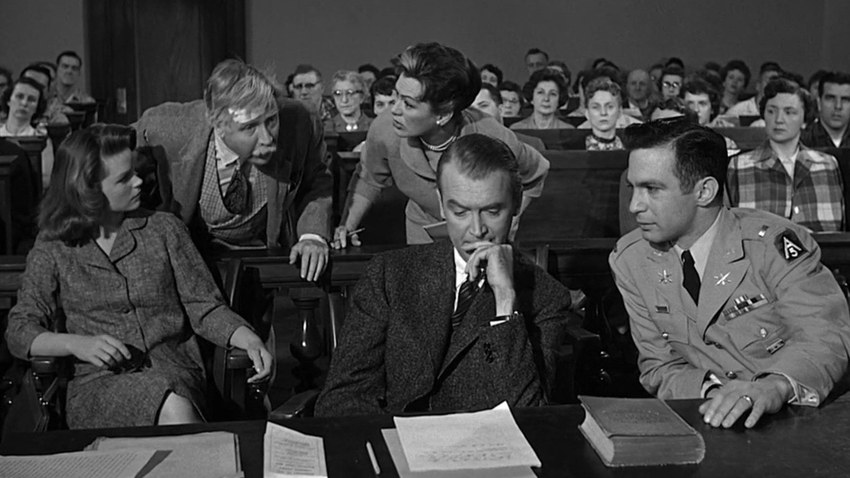
El segundo ángulo de la película es menos técnico y quizá más valioso para la formación: enseña que un mismo hecho se analiza de manera seria y distinta según quién lo mire. Preminger no toma partido y deja que cada profesional construya su versión con los mismos materiales.
- La defensa. Biegler busca un relato que encaje en una categoría legal. Su pregunta es qué puede probarse y qué admite la ley, y deja en segundo plano qué ocurrió exactamente.
- La acusación. El fiscal local y Claude Dancer, enviado desde la fiscalía general del estado, leen el mismo hecho como una venganza con tiempo para pensar, alimentada por los celos. El intervalo entre el relato de Laura y los disparos es su mejor argumento.
- La psiquiatría. Dos peritos con el mismo acusado delante llegan a conclusiones opuestas. La escena permite discutir qué es un diagnóstico retrospectivo y cuánto se le puede pedir.
- La víctima. En realidad son dos: Laura, cuya palabra se pone en duda, y Quill, el muerto, cuyo carácter también se juzga. La revelación final sobre Mary Pilant, que resulta ser su hija, recuerda que detrás de cada víctima hay una familia.
- El juez. Weaver mantiene el orden con humor, decide qué se oye en la sala y llega a negociar en público la palabra con que se nombrará una prenda interior, una escena que en 1959 rozaba el escándalo y que hoy sirve para hablar del lenguaje del proceso.
- El jurado y el pueblo. Doce vecinos que deben decidir con lo que se les permite saber, rodeados de una comunidad que ya tiene su opinión. La película no muestra la deliberación, y esa ausencia también se puede trabajar en clase.
Una dinámica sencilla consiste en repartir estos seis papeles entre grupos de alumnos y pedir a cada uno que reconstruya el crimen desde su posición, con las pruebas que la película le da y sin las que no tiene. Al poner en común los seis relatos aparece la idea de fondo: la verdad procesal es una construcción con reglas, y conocer esas reglas es la única forma de juzgar si fueron justas.
Propuesta para el aula: «la lección»

Hay una escena que, por sí sola, justifica llevar la película a clase. En su primera entrevista con Manion, antes de que este le cuente qué pasó, Biegler le explica que una acusación de asesinato solo admite unas pocas defensas: que no fue un asesinato, que no lo cometió él, que estaba justificado o que tiene una excusa legal. Le aclara que la violación de su esposa no justifica matar a nadie cuando ya ha pasado un tiempo y le invita a pensar en lo que sentía en ese momento. Manion entiende enseguida y empieza a recordar que se le nubló la mente. Más adelante, cuando le preguntan si le dio «la lección» a su cliente, Biegler responde que, si con eso se refieren a que le preparó una historia falsa, la respuesta es no. La película no aclara quién dice la verdad.
La pregunta de debate es directa: ¿explicar la ley al cliente antes de oír su versión es asesoramiento legítimo o la fabricación de una defensa? Tiene la ventaja de que no admite respuestas fáciles y de que enfrenta dos deberes reales del abogado, el de defender con todos los medios legales y el de no faltar a la verdad ante el tribunal.
Los alumnos pueden apoyarse en un clásico de la ética jurídica. En 1966, Monroe Freedman publicó en la Michigan Law Review un artículo sobre las que llamó las tres preguntas más difíciles del abogado penalista; la tercera era si resulta correcto dar a un cliente un consejo legal cuando se sabe que puede tentarle a mentir. Freedman respondió que sí, por el derecho del acusado a conocer la ley que se le aplica, y el artículo provocó una polémica que sigue viva. Enfrente están las normas actuales: las Reglas Modelo de Conducta Profesional de la Asociación Americana de la Abogacía prohíben aconsejar o ayudar a un testigo a declarar en falso, y la preparación de testigos se admite mientras no se altere el contenido del testimonio. En España, el artículo 461 del Código Penal castiga a quien presenta a sabiendas testigos falsos, con la pena en su mitad superior e inhabilitación si lo hace un abogado, aunque el acusado, que no es testigo, no comete falso testimonio al declarar.
Una posible organización en dos sesiones, adaptable al tiempo disponible:
- Antes del visionado (15 minutos). Lectura breve de los artículos 20.1 y 21.3 del Código Penal, del 709 de la Ley de Enjuiciamiento Criminal y de un resumen de las tres preguntas de Freedman. Se pide a cada alumno que anote su respuesta inicial a la pregunta de debate.
- Visionado. La película completa como tarea previa o, en clase, cinco fragmentos: la entrevista en la oficina del sheriff, el interrogatorio de Laura, el testimonio de los dos psiquiatras, la instrucción del juez al jurado y el desenlace.
- Debate en formato de juicio deontológico (50 minutos). Un grupo sostiene que Biegler asesoró de forma legítima; otro, que indujo a su cliente a construir una coartada. Un tribunal de tres alumnos escucha a ambos y redacta una resolución motivada, igual que debe hacerlo un jurado español.
- Puesta en común (20 minutos). Qué cambiaría si el juicio se celebrase en España en 2026 y si el final de la película, en el que Manion se marcha sin pagar y lo atribuye a un «impulso irresistible», modifica la opinión del grupo.
Algunas preguntas guía para el debate: ¿en qué momento exacto deja Biegler de informar y empieza a sugerir?; ¿habría actuado igual si supiera que su cliente miente?; ¿debe un abogado creer a su cliente?; ¿por qué la acusación necesita destruir la credibilidad de Laura si quien está juzgado es su marido?; ¿qué peso real tiene la instrucción de un juez cuando el jurado ya ha oído algo?; ¿se habría absuelto a Manion con el artículo 20.1 del Código Penal español?
Según la materia, el mismo material permite otros enfoques. En Psicología jurídica, la credibilidad del testimonio y los sesgos del jurado; en Psiquiatría forense, el diagnóstico retrospectivo y los límites del peritaje sobre la imputabilidad; en Victimología, la victimización secundaria de Laura durante el proceso; en Criminología, la reacción social ante un crimen pasional en una comunidad pequeña.
Por qué sigue mereciendo la pena, y con qué cautelas
Anatomía de un asesinato tiene limitaciones que conviene explicitar ante los alumnos. Es larga, avanza con calma y retrata un mundo jurídico sin mujeres en la toga, en el que la víctima de una violación es tratada con una mezcla de desconfianza y paternalismo que hoy resulta difícil de ver. Precisamente por eso funciona tan bien en clase: permite medir la distancia entre lo que se consideraba normal en 1959 y lo que hoy prohíben las leyes, y obliga a preguntarse qué prácticas actuales parecerán igual de inaceptables dentro de setenta años.
La película tampoco ofrece un héroe. Biegler es simpático, brillante y quizá demasiado hábil; Manion puede ser un marido enajenado o un hombre celoso que encontró a tiempo al abogado adecuado; Laura puede ser una víctima o una mujer que tuvo que adaptar su relato. Esa ambigüedad, que molestó a parte de la crítica de su época, es su mayor virtud docente, porque obliga a argumentar en lugar de aplaudir. Está disponible en edición doméstica y, según el momento, en plataformas de vídeo bajo demanda, en versión doblada y en versión original con subtítulos. Para el aula, la versión original permite además trabajar el vocabulario jurídico inglés que la película maneja con notable precisión.
«Anatomy of a Murder»: the trial that is still teaching
Otto Preminger’s 1959 film as a classroom resource: what has changed in criminal procedure since then, how a crime is analysed through the eyes of each professional, and why the «lecture» scene still divides students.
How far can a lawyer go to save a client?
Author: Manuel Castelló G. y José Francisco L. Alonso
A murder nobody gets to see
In a small town on Michigan’s Upper Peninsula, army lieutenant Frederick Manion walks into the bar of the local inn and shoots its owner, Barney Quill, dead. He neither runs nor denies it. His wife, Laura, says that Quill raped and beat her that same night. The case lands on Paul Biegler, a former county prosecutor who lost his re-election and spends his days fishing for trout, playing jazz on the piano and arguing law with an old friend who drinks too much. That is how Anatomy of a Murder (Otto Preminger, 1959) begins, and the most striking feature of its two hours and forty minutes is what it keeps off screen, because the viewer never sees the rape or the shooting. Everything we learn about the crime comes from what the characters say, what the judge allows to be said and what the jury ends up believing.
That script decision, almost a provocation in 1959, turns the film into first-rate material for any law, criminology or legal psychology classroom. James Stewart, Lee Remick, Ben Gazzara and a young George C. Scott carry a trial shot in the real Marquette County courthouse, with music by Duke Ellington and titles by Saul Bass. It received seven Academy Award nominations, won none, and was added to the US National Film Registry in 2012. For the judge, Preminger cast Joseph N. Welch, the lawyer who in 1954 had faced down Senator Joseph McCarthy on live television, so the fictional magistrate came with a genuine courtroom career behind him.
With this film, the Cinema with rigour series shifts its focus. From now on, each title is offered as a teaching resource for lecturers, trainers and specialists who want to bring law and the forensic sciences into the classroom in an engaging way, with a specific debate question and an activity that can be used the very next day. This article looks at Anatomy of a Murder from two angles: how much criminal procedure has changed since 1959, which is the main thread, and how a single crime is analysed seriously through the eyes of each professional involved. The proposed debate revolves around the film’s most discussed scene, the so-called «lecture».
Classroom sheet
- Original title: Anatomy of a Murder (United States, 1959), black and white, 160 minutes.
- Direction and screenplay: Otto Preminger; screenplay by Wendell Mayes from the novel by Robert Traver (1958).
- Subjects: Criminal Law and Criminal Procedure, Professional Ethics, Legal and Forensic Psychology, Forensic Psychiatry, Criminology and Victimology.
- Recommended level: undergraduate and postgraduate; with selected excerpts, also upper secondary and vocational training.
- Debate question: Is explaining the law to a client before hearing his account legitimate advice, or the manufacture of a defence?
- Warning: it deals with a rape and a homicide, with the language and prejudices of its time, which should be introduced and discussed.
From the Peterson case to a judge’s novel
The story has an original. On 31 July 1952, Lieutenant Coleman A. Peterson shot Maurice Chenoweth dead at the Lumberjack Tavern in Big Bay, a village on the shore of Lake Superior; his wife, Charlotte, stated that Chenoweth had raped and beaten her. The defence lawyer was John D. Voelker, a long-serving county prosecutor, who raised a variant of the insanity defence that had been all but forgotten in Michigan since 1886: irresistible impulse. The trial opened on 15 September and, on the 23rd, the jury acquitted Peterson by reason of insanity after about four hours of deliberation. Two days later a psychiatrist declared him sane and he was released.
Voelker told the story in a novel he signed as Robert Traver and published in 1958, by which time he sat on the Michigan Supreme Court. The book’s success allowed him to leave the bench and devote himself to writing and fishing. The film followed the novel very closely and was shot in the same places, so closely that in 1960 Chenoweth’s daughter sued the publisher and Columbia Pictures for libel, arguing that the fiction copied the facts and portrayed the women involved unfavourably; the suit was dismissed in 1961. For the classroom, that lawsuit opens a side question that also deserves debate: what obligations does anyone who turns a real crime into entertainment owe to the victims and their families?
What has changed in the courtroom since 1959
Seen today, the film works as a photograph of a procedural system that no longer exists as it was. Almost every conflict in the trial has a different legal answer seventy years on, and going through them makes it possible to explain, with a concrete case, why the rules changed.
Madness before the court
Biegler needs a legal way out because Manion killed Quill a good while after hearing his wife’s account, when self-defence was no longer an option. The general rule in 1959 was the M’Naghten test, formulated in England in 1843, which excuses only those who, because of mental disease, do not know what they are doing or do not know that it is wrong. Manion knew. Biegler’s associate then finds in the law library a Michigan Supreme Court decision, People v. Durfee (1886), which also accepted an inability to resist an impulse, provided it arose from disease and not from mere anger. That precedent carries the whole defence: the army psychiatrist speaks of a «dissociative reaction», and the prosecution’s expert replies that no underlying disorder has been shown to explain it (Weiss, 2023).
The later history of that formula is the most instructive part. In 1962 the American Law Institute’s Model Penal Code combined the cognitive and the volitional criteria. Twenty years later, the insanity acquittal of John Hinckley, who had shot President Reagan in 1981, triggered an immediate reaction: the Insanity Defense Reform Act of 1984 removed the volitional prong in federal courts, placed on the defendant the burden of proving insanity by clear and convincing evidence, and barred experts from stating whether the defendant had the mental state that constitutes an element of the offence. Several states tightened their rules or abolished the defence outright, and in Kahler v. Kansas (2020) the US Supreme Court held that a state may dispense with the moral-incapacity test. In 1975 Michigan became the first state to create the «guilty but mentally ill» verdict, and today it keeps an ALI-type formula including the volitional prong, although since 1994 it is the defence that must prove insanity by a preponderance of the evidence. According to Weiss (2023), some twenty US jurisdictions retain a version of the volitional test.
Students should be given the real scale of the phenomenon. In the eight-state study by Callahan et al. (1991), the defence was raised in about 1 % of felony cases and succeeded in only 26 % of them. Insanity acquittals are far rarer in court than in the cinema.
In Spain the starting point is different. Article 20.1 of the Criminal Code exempts anyone who, because of a psychological anomaly or disturbance, cannot understand the unlawfulness of the act or act in accordance with that understanding; the second half of the sentence is precisely the volitional prong the US federal legislator removed in 1984. A transient mental disorder does not exempt if the person brought it about in order to offend, and acquittal may come with a security measure, since Article 101 allows committal to an institution for no longer than the sentence that would otherwise have applied. A case like Manion’s would probably be argued in other terms, such as the mitigating circumstance of passion or blind rage in Article 21.3 or an incomplete exemption, against a sentence for homicide of ten to fifteen years’ imprisonment. That contrast is in itself a good exercise: acquittal, mitigation or full conviction?
The victim in the dock
The central paradox of the trial is that the rape is never tried, because the alleged rapist is dead, and yet it takes up half the film. The defence needs the jury to believe Laura in order to explain her husband’s outburst; the prosecution needs to discredit her. The result is a minute examination of her life: how she dressed, whether she drank, whether she flirted with other men, whether her husband doubted her fidelity to the point of making her swear on a rosary. Biegler, for his part, asks her to watch her appearance in front of the jury. Laura is a witness, a victim and, in practice, a defendant.
Few rules have changed as much. In 1974 Michigan passed one of the first US laws shielding victims from their sexual history (a rape shield law), in force from April 1975, which admits such evidence only in narrowly defined cases and after a ruling by the judge; the Federal Rules of Evidence incorporated an equivalent provision, Rule 412, in 1978. There is a nuance students should be left to discover for themselves: those laws protect the complainant in prosecutions for sexual offences, and Manion’s is a murder trial. Even today, the protection would not apply to Laura automatically.
In Spain, the Victims’ Statute (Act 4/2015) provides for measures to prevent questions about private life that are irrelevant to the facts, and Article 709 of the Criminal Procedure Act, as worded by Organic Act 10/2022, empowers the presiding judge to prevent unnecessary questions about the victim’s sexual privacy and not to allow them to be answered. Research supports the caution: the systematic review by Dinos et al. (2015) concluded that rape myths influence how jurors assess victims and the verdicts they reach. Without meaning to, the film offers a complete catalogue of those myths.
Expert against expert
The duel between the army psychiatrist and the prosecution’s expert is another of the moments that has aged the most. In 1959 the Frye standard of 1923 applied, admitting scientific evidence if it enjoyed general acceptance in its field. Since Daubert v. Merrell Dow Pharmaceuticals (1993), US federal judges act as gatekeepers and assess an expert’s methodology before letting him testify, a model many states have since adopted. Moreover, after the 1984 reform, in a federal court Biegler’s psychiatrist could not say what he says in the film, that the defendant acted under an irresistible impulse: that conclusion is reserved for the jury.
In Spanish proceedings, experts testify at the oral trial and the court assesses their report freely; in cases involving criminal responsibility, the forensic physicians of the Institutes of Legal Medicine and Forensic Sciences frequently take part. A useful exercise is to ask students to draft the questions they would put to each of the film’s experts in order to test whether the diagnosis rests on an examination and on data, or on the convenience of the party that called the witness.
What the jury hears and should not hear
One of the film’s most quoted exchanges asks, in essence, how a jury is supposed to forget what it has already heard. Biegler introduces information he knows will be struck out, the judge instructs the jury to disregard it, and the damage is done. Jury psychology has proved him right: the meta-analysis by Steblay et al. (2006), covering 48 studies and more than 8,000 participants, concluded that an instruction to ignore inadmissible evidence does not eliminate its effect on verdicts, although compliance improves somewhat when the judge explains why the evidence is excluded.
The Spanish jury is also different. Homicide falls within the jurisdiction of the Jury Court, made up of nine citizens and a presiding professional judge; seven votes are needed to find proven the facts against the defendant and to convict, and five for those in the defendant’s favour. Above all, a Spanish jury must give a brief statement of the reasons for its verdict, whereas an American jury decides without giving reasons. There is also a fundamental difference: in Spain the defendant testifies without taking an oath and with the constitutional right not to incriminate himself, which completely changes the risk that weighs on Manion in the film when he takes the stand.
One crime, six perspectives
The film’s second angle is less technical and perhaps more valuable for training: it shows that the same event is analysed seriously, and differently, depending on who is looking. Preminger takes no side and lets each professional build a version out of the same materials.
- The defence. Biegler looks for an account that fits a legal category. His question is what can be proved and what the law allows, and exactly what happened takes second place.
- The prosecution. The local prosecutor and Claude Dancer, sent from the state attorney general’s office, read the same event as revenge with time to think, fuelled by jealousy. The interval between Laura’s account and the shots is their best argument.
- Psychiatry. Two experts facing the same defendant reach opposite conclusions. The scene opens a discussion on what a retrospective diagnosis is and how much can be asked of it.
- The victim. There are really two: Laura, whose word is doubted, and Quill, the dead man, whose character is also put on trial. The final revelation about Mary Pilant, who turns out to be his daughter, is a reminder that behind every victim there is a family.
- The judge. Weaver keeps order with humour, decides what is heard in the courtroom and even negotiates in open court the word to be used for an item of underwear, a scene that bordered on scandal in 1959 and is useful today for discussing the language of the courtroom.
- The jury and the town. Twelve neighbours who must decide on what they are allowed to know, surrounded by a community that has already made up its mind. The film does not show the deliberation, and that absence can also be worked on in class.
A simple activity is to give these six roles to groups of students and ask each group to reconstruct the crime from its position, with the evidence the film provides and without what it lacks. When the six accounts are compared, the underlying idea emerges: procedural truth is a construction governed by rules, and knowing those rules is the only way to judge whether they were fair.
A classroom proposal: «the lecture»
One scene alone justifies taking the film into the classroom. At their first meeting, before Manion has told him what happened, Biegler explains that a murder charge admits only a few defences: that it was not murder, that he did not do it, that it was justified, or that he has a legal excuse. He makes clear that his wife’s rape does not justify killing someone after time has passed and invites him to think about what he was feeling at that moment. Manion catches on at once and begins to remember that his mind went blank. Later, when asked whether he gave his client «the lecture», Biegler replies that, if that means coaching him into a false story, the answer is no. The film never settles who is telling the truth.
The debate question is straightforward: is explaining the law to a client before hearing his account legitimate advice, or the manufacture of a defence? It has the advantage of allowing no easy answers and of setting two real duties of the lawyer against each other: to defend with every lawful means and not to deceive the court.
Students can draw on a classic of legal ethics. In 1966 Monroe Freedman published in the Michigan Law Review an article on what he called the three hardest questions facing a criminal defence lawyer; the third was whether it is proper to give a client legal advice when one knows it may tempt him to lie. Freedman answered yes, on the ground of the accused’s right to know the law that applies to him, and the article sparked a controversy that is still alive. On the other side stand the current rules: the American Bar Association’s Model Rules of Professional Conduct forbid counselling or assisting a witness to testify falsely, and witness preparation is accepted as long as the content of the testimony is not altered. In Spain, Article 461 of the Criminal Code punishes anyone who knowingly presents false witnesses, with the penalty in its upper half and disqualification when a lawyer does it, although the defendant, who is not a witness, does not commit perjury when testifying.
One possible structure over two sessions, adaptable to the time available:
- Before viewing (15 minutes). A short reading of Articles 20.1 and 21.3 of the Spanish Criminal Code, Article 709 of the Criminal Procedure Act and a summary of Freedman’s three questions. Each student writes down an initial answer to the debate question.
- Viewing. The whole film as prior homework or, in class, five excerpts: the meeting in the sheriff’s office, the cross-examination of Laura, the testimony of the two psychiatrists, the judge’s instruction to the jury, and the ending.
- Debate as a professional-conduct hearing (50 minutes). One group argues that Biegler gave legitimate advice; another, that he led his client to build an alibi. A panel of three students hears both sides and drafts a reasoned decision, just as a Spanish jury must do.
- Wrap-up (20 minutes). What would change if the trial took place in Spain in 2026, and whether the ending of the film, in which Manion leaves without paying and blames it on an «irresistible impulse», alters the group’s view.
Some guiding questions for the debate: at what exact moment does Biegler stop informing and start suggesting?; would he have acted the same way if he knew his client was lying?; should a lawyer believe his client?; why does the prosecution need to destroy Laura’s credibility when it is her husband who is on trial?; how much real weight does a judge’s instruction carry once the jury has heard something?; would Manion have been acquitted under Article 20.1 of the Spanish Criminal Code?
Depending on the subject, the same material supports other approaches. In legal psychology, the credibility of testimony and jury bias; in forensic psychiatry, retrospective diagnosis and the limits of expert evidence on criminal responsibility; in victimology, the secondary victimisation Laura suffers during the proceedings; in criminology, the social reaction to a crime of passion in a small community.
Why it is still worth it, and with what caveats
Anatomy of a Murder has limitations that are best made explicit to students. It is long, unhurried and portrays a legal world with no women in robes, in which a rape victim is treated with a mixture of distrust and paternalism that is hard to watch today. That is exactly why it works so well in class: it measures the distance between what was considered normal in 1959 and what the law forbids today, and it forces the question of which current practices will seem just as unacceptable seventy years from now.
Nor does the film offer a hero. Biegler is likeable, brilliant and perhaps too clever; Manion may be a husband driven out of his mind or a jealous man who found the right lawyer in time; Laura may be a victim or a woman who had to adjust her story. That ambiguity, which troubled some critics at the time, is its greatest teaching virtue, because it forces students to argue rather than applaud. It is available on home video and, depending on the moment, on video-on-demand platforms, both dubbed and in the original version with subtitles. In the classroom, the original version also allows work on the English legal vocabulary the film handles with remarkable precision.
Bibliografía / References
American Bar Association. (1983). Model rules of professional conduct (versión vigente, regla 3.4, «Fairness to opposing party and counsel»). https://www.americanbar.org/groups/professional_responsibility/publications/model_rules_of_professional_conduct/
Callahan, L. A., Steadman, H. J., McGreevy, M. A., & Robbins, P. C. (1991). The volume and characteristics of insanity defense pleas: An eight-state study. Bulletin of the American Academy of Psychiatry and the Law, 19(4), 331–338. https://jaapl.org/content/19/4/331
Daubert v. Merrell Dow Pharmaceuticals, Inc., 509 U.S. 579 (1993).
Dinos, S., Burrowes, N., Hammond, K., & Cunliffe, C. (2015). A systematic review of juries’ assessment of rape victims: Do rape myths impact on juror decision-making? International Journal of Law, Crime and Justice, 43(1), 36–49. https://doi.org/10.1016/j.ijlcj.2014.07.001
Freedman, M. H. (1966). Professional responsibility of the criminal defense lawyer: The three hardest questions. Michigan Law Review, 64(8), 1469–1484. https://doi.org/10.2307/1287199
Insanity Defense Reform Act of 1984, 18 U.S.C. § 17.
Kahler v. Kansas, 589 U.S. 271 (2020).
Ley 4/2015, de 27 de abril, del Estatuto de la víctima del delito. Boletín Oficial del Estado, 101, de 28 de abril de 2015. https://www.boe.es/eli/es/l/2015/04/27/4/con
Ley Orgánica 5/1995, de 22 de mayo, del Tribunal del Jurado. Boletín Oficial del Estado, 122, de 23 de mayo de 1995. https://www.boe.es/eli/es/lo/1995/05/22/5/con
Ley Orgánica 10/1995, de 23 de noviembre, del Código Penal. Boletín Oficial del Estado, 281, de 24 de noviembre de 1995. https://www.boe.es/eli/es/lo/1995/11/23/10/con
Ley Orgánica 10/2022, de 6 de septiembre, de garantía integral de la libertad sexual. Boletín Oficial del Estado, 215, de 7 de septiembre de 2022. https://www.boe.es/eli/es/lo/2022/09/06/10
Michigan Compiled Laws § 750.520j (protección de la víctima en los delitos sexuales, 1974 PA 266) y § 768.21a (eximente de enajenación). https://www.legislature.mi.gov/
People v. Durfee, 62 Mich. 487 (1886).
Preminger, O. (Director). (1959). Anatomy of a murder [Película]. Carlyle Productions; Columbia Pictures.
Real Decreto de 14 de septiembre de 1882 por el que se aprueba la Ley de Enjuiciamiento Criminal. Boletín Oficial del Estado (texto consolidado). https://www.boe.es/eli/es/rd/1882/09/14/(1)/con
Steblay, N., Hosch, H. M., Culhane, S. E., & McWethy, A. (2006). The impact on juror verdicts of judicial instruction to disregard inadmissible evidence: A meta-analysis. Law and Human Behavior, 30(4), 469–492. https://doi.org/10.1007/s10979-006-9039-7
Traver, R. [Voelker, J. D.]. (1958). Anatomy of a murder. St. Martin’s Press.
Weiss, K. J. (2023). Red mist and the irresistible defense of «losing it». Journal of the American Academy of Psychiatry and the Law, 51(3), 431–435. https://doi.org/10.29158/JAAPL.230054-23
Créditos de las imágenes / Image credits
Todas las imágenes de este artículo, incluida la portada, son fotogramas o materiales promocionales de Anatomía de un asesinato (Anatomy of a Murder, Otto Preminger, 1959), © Carlyle Productions / Columbia Pictures, reproducidos en baja resolución (ancho máximo 850 px) y en número limitado al amparo del derecho de cita y del uso legítimo con fines de crítica, reseña, comentario y docencia. Todos los derechos sobre la obra pertenecen a sus titulares. Fuente de las imágenes: The Movie Database (image.tmdb.org).
All images in this article, including the cover, are stills or promotional materials from Anatomy of a Murder (Otto Preminger, 1959), © Carlyle Productions / Columbia Pictures, reproduced at low resolution (maximum width 850 px) and in limited number under the right of quotation and fair use for the purposes of criticism, review, comment and teaching. All rights in the work belong to their owners. Image source: The Movie Database (image.tmdb.org).

Deja una respuesta